Wat Suthatวัดสุทัศนเทพวราราม

Bangkok · Temple with murals, Buddha images and a separate museum

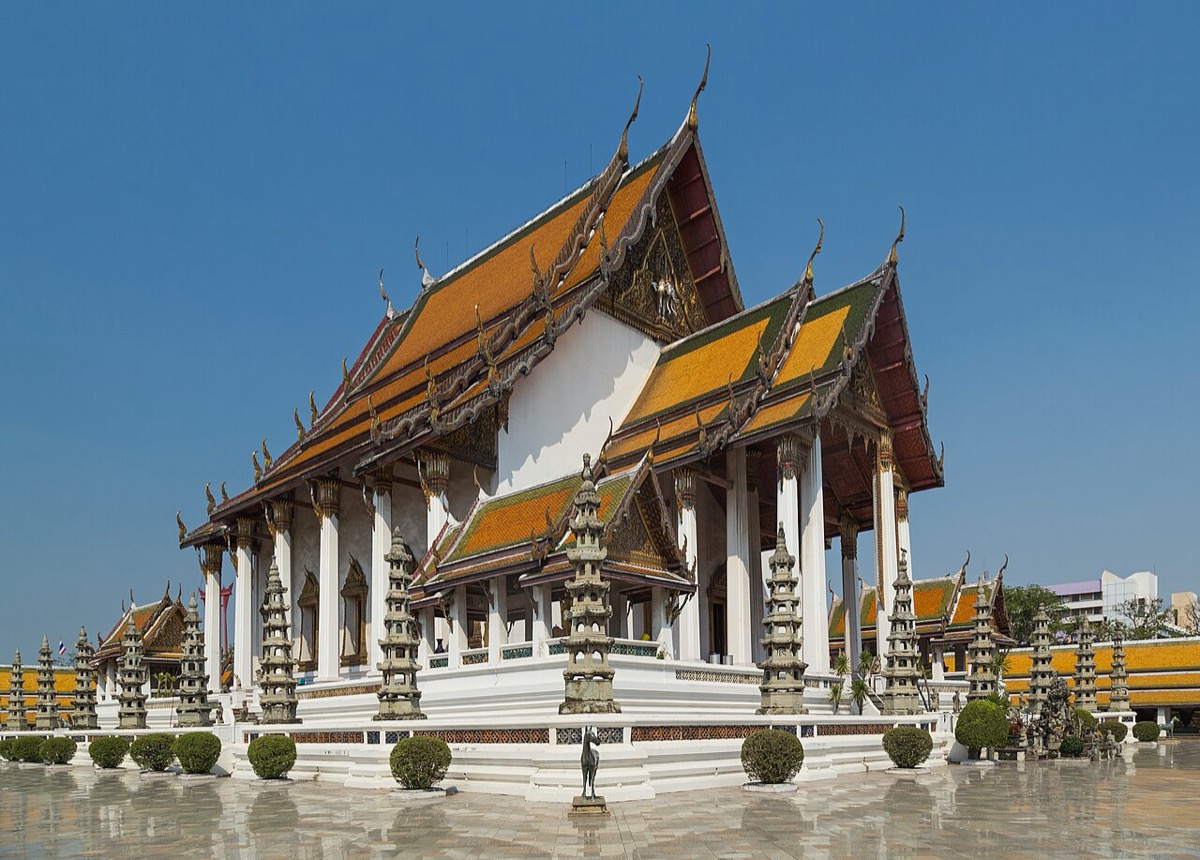
Wat Suthat is a temple in Bangkok’s old city where you can see the large red Giant Swing outside, murals inside the viharn and finely carved wooden doors. Take in the Sisaakayamuni Buddha image on its high pedestal and the paintings on the walls for a closer look at the temple beyond its street view.

A separately listed museum is open 09:30–16:00 on Friday, Saturday, Sunday and public holidays, with admission at 200 baht. The temple is open 08:30–20:00, with admission at 100 baht. If you want to visit both on the same day, plan around the museum’s limited opening days and earlier closing time.

Location and getting there

The pin marks the place, not necessarily its entrance, ticket office or vehicle drop-off point.

Address

146 Bamrungmuang Rd, Phra Nakorn, Bangkok 10200

Walk from Sam Yot MRT station

It is listed as about a 10-minute walk from Sam Yot station (BL30) on the MRT Blue Line. The destination is Wat Suthat at 146 Bamrungmuang Road.

Essential visitor information

Temple
08:30–20:00 · 100 baht
Museum
Friday, Saturday, Sunday and public holidays, 09:30–16:00 · 200 baht

What can you see?

The Sisaakayamuni Buddha on a high pedestal

Sisaakayamuni is a large bronze Buddha image made in the Sukhothai period. The image is about 8 metres tall and sits on a pedestal about 6 metres high. Step into the viharn and look up to appreciate the scale of the image and its base.

After seeing the red Giant Swing outside, enter the viharn to find the Buddha image raised high above you and paintings on the walls. Rather than taking a street-side photo and moving on, set aside time to look up at the large image and take in the murals.

Murals and finely carved wooden doors

The temple was begun in the early 19th century during the reign of Rama I. It is known for its murals and intricately carved wooden doors, so look at both the image and the building’s walls and entrances. Take time to alternate between the large paintings and small carved details.

Near the doors, look at the patterns carved into the wood; inside, explore the scenes depicted across the murals. Even if Buddhist art is unfamiliar, you can follow the delicate lines of the carvings and the images spread across the walls.

The Giant Swing and the temple’s other stories

Sao Ching Cha, the Giant Swing in front of the temple, consists of red posts and a crossbar. The Tourism Authority of Thailand says it was used in a Brahmin ceremony that was discontinued long ago. Do not mistake the historic structure for a ride or an event that is still taking place.

The swing is outside the temple, while the Sisaakayamuni Buddha and 19th-century murals are inside the viharn. Seeing the historic structure associated with an earlier Brahmin ceremony and then entering the temple lets you explore art from different religious traditions and periods. The museum is listed separately as open 09:30–16:00 on Friday, Saturday, Sunday and public holidays, closing before the temple.

Before you visit

The temple and museum have different hours

The temple is listed as 08:30–20:00, 100 baht; the separate museum is 09:30–16:00 on Friday, Saturday, Sunday and public holidays, 200 baht. If visiting the museum, plan around its earlier closing time.

What to wear at the temple

Visitors of all genders are advised to wear clothing that covers the shoulders and knees. A top with sleeves and long trousers or a skirt covering the knees are suitable choices. Please dress modestly rather than wearing a sleeveless top or short bottoms.

Frequently asked questions

Is the Giant Swing inside the temple?

The red Giant Swing is outside the temple. It was once used for a Brahmin ceremony, which has since been discontinued. Inside the viharn, you can see the Sisaakayamuni Buddha on a high pedestal, murals and carved wooden doors.

Is the museum open at the same times as the temple?

The temple is listed as open 08:30–20:00 with admission at 100 baht. The museum is separately listed as open 09:30–16:00 on Friday, Saturday, Sunday and public holidays, with admission at 200 baht. The museum opens on fewer days and closes earlier.

Sources checked:

Official sources · 3

Sharing image credit: Marcin Konsek / Wikimedia Commons · CC BY-SA 4.0