
Is Phimai Historical Park in central Korat?
No. It is in Phimai, about 59 km from central Korat. Allow separate travel time there and back rather than treating it as a stop in central Korat.
Nakhon Ratchasima · Phimai · Khmer stone temple ruins at Phimai
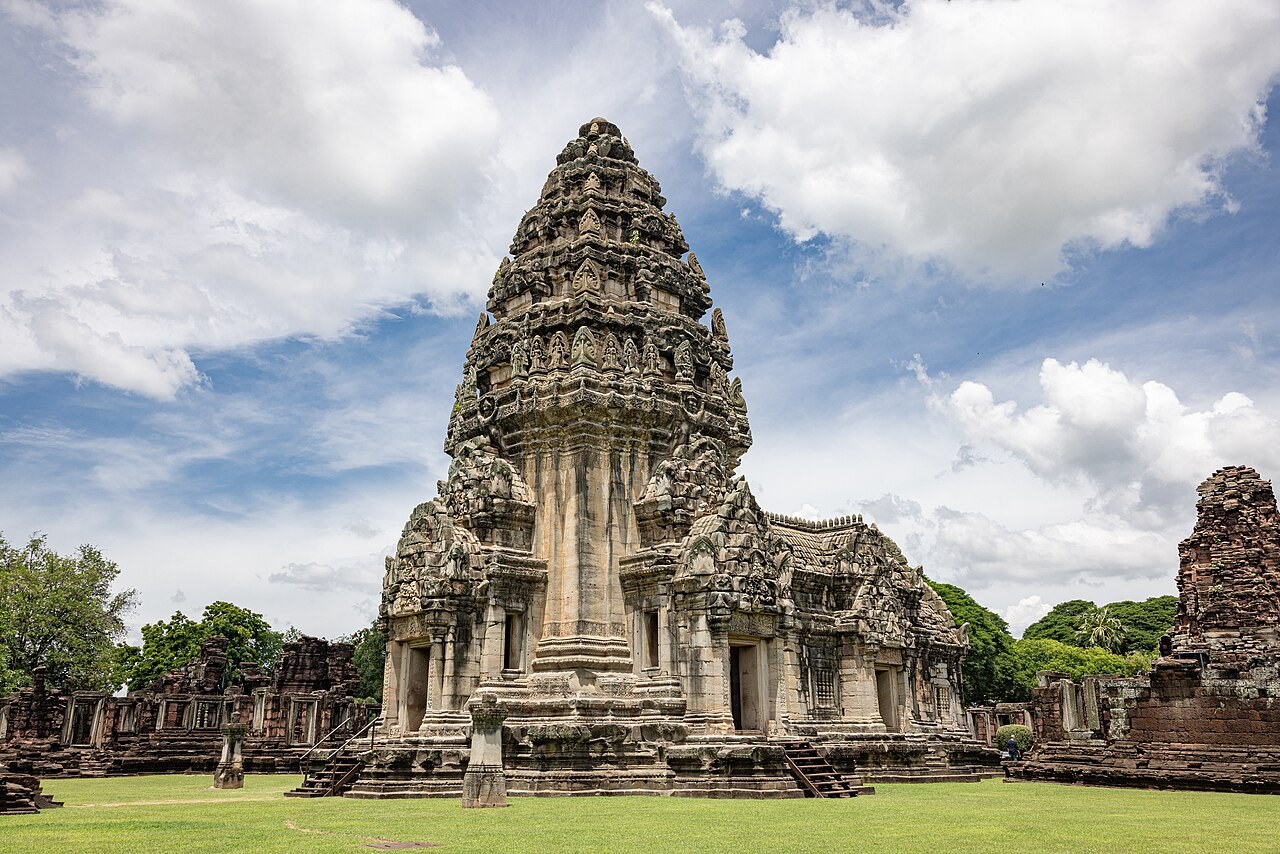
Phimai Historical Park is a place to see a Khmer stone temple in Nakhon Ratchasima, in northeastern Thailand. Walk from a bridge guarded by a seven-headed naga through gateways and galleries to the central sandstone sanctuary.
Look for carved Buddhas and Hindu deities, petal-like roof ornaments and a courtyard with ponds. The stone colours and carvings offer a different experience from temples with extensive gold decoration. Phimai was connected by a route to the old Khmer capital of Angkor, making it a compelling stop for anyone interested in Khmer-era temples in Thailand.
The pin marks the place, not necessarily its entrance, ticket office or vehicle drop-off point.
Tambon Nai Mueang, Amphoe Phimai Chang Wat Nakhon Ratchasima 30110
Set your destination to Phimai Historical Park, Nai Mueang, Phimai. It is described as about 59 km from central Korat, so arrange separate transport for the return journey as well.
Phimai’s appeal lies not only in the broad outline of its Khmer stone sanctuary but also in the carvings that remain in the stone. Sculptures of Buddhas and Hindu deities appear together, showing how Buddhist and Hindu imagery was expressed in temple architecture.
The colours and materials differ from Bangkok’s richly gilded temples. After walking around the towers, look near the doorways for smaller figures and patterns carved into the stone. If you enjoy stone architecture, take your time with the surfaces and carvings.
Routes from Phimai once linked to Angkor, the capital of the old Khmer Empire. Although the area is now divided between Thailand and Cambodia, religion and culture travelled along these routes in the past.
The courtyard has four ponds, and layered roof decorations resemble overlapping flower petals. After seeing the central tower, explore the courtyard and doorways. This is not a newly built replica modelled on Angkor Wat; it is a temple with remains from the old Khmer period.
At the southern entrance stands a sandstone bridge carved with a seven-headed naga. Its long body forms the balustrade, with the heads spreading out at the end. As you pass through the gateway, also look at the balustrades and the lion sculptures beneath the stairs.
The naga bridge is interpreted in Buddhist and Hindu cosmology as a path linking the human world with heaven. Religious meaning is built into the approach to the temple too. Walk from the bridge towards the central tower and notice the carvings on the balustrades, gateway and steps.
The central sanctuary is built of pale sandstone, while red stone towers and galleries remain in the surrounding area. Compare the colours and surfaces of the different structures and see how the doorways and galleries frame the central sanctuary.
What you see today combines ancient remains and modern restoration. In the 1960s, the Thai Fine Arts Department worked with France to restore the central sanctuary by matching scattered architectural pieces to their original positions. This is a researched and conserved historic site, not a newly made themed building.
No. It is in Phimai, about 59 km from central Korat. Allow separate travel time there and back rather than treating it as a stop in central Korat.
See the southern bridge with its seven-headed naga, sandstone towers and steps with lion sculptures. Compare the pale central tower with the red towers to notice differences in material and decoration.
No. It is a restored Khmer historic site. During joint Thai–French restoration in the 1960s, surviving architectural pieces were reassembled.
Sources checked:
Sharing image credit: Mastertongapollo / Wikimedia Commons · CC BY-SA 4.0