
Is the large white statue on the hill a Buddha?
No. The complex’s landmark is Guanyin, described as a 69-metre statue. The grounds also have a separate nine-storey pagoda with red roofs and a white hall decorated with plasterwork.
Chiang Rai · Chiang Rai temple with a Guanyin image and multi-tiered pagoda
Wat Huai Pla Kang is a temple complex on a hill in the Rim Kok area of Chiang Rai, where a large white Guanyin statue stands alongside multi-storey pagodas. It is easy to mistake the white statue for a Buddha, but the complex’s landmark is Guanyin.
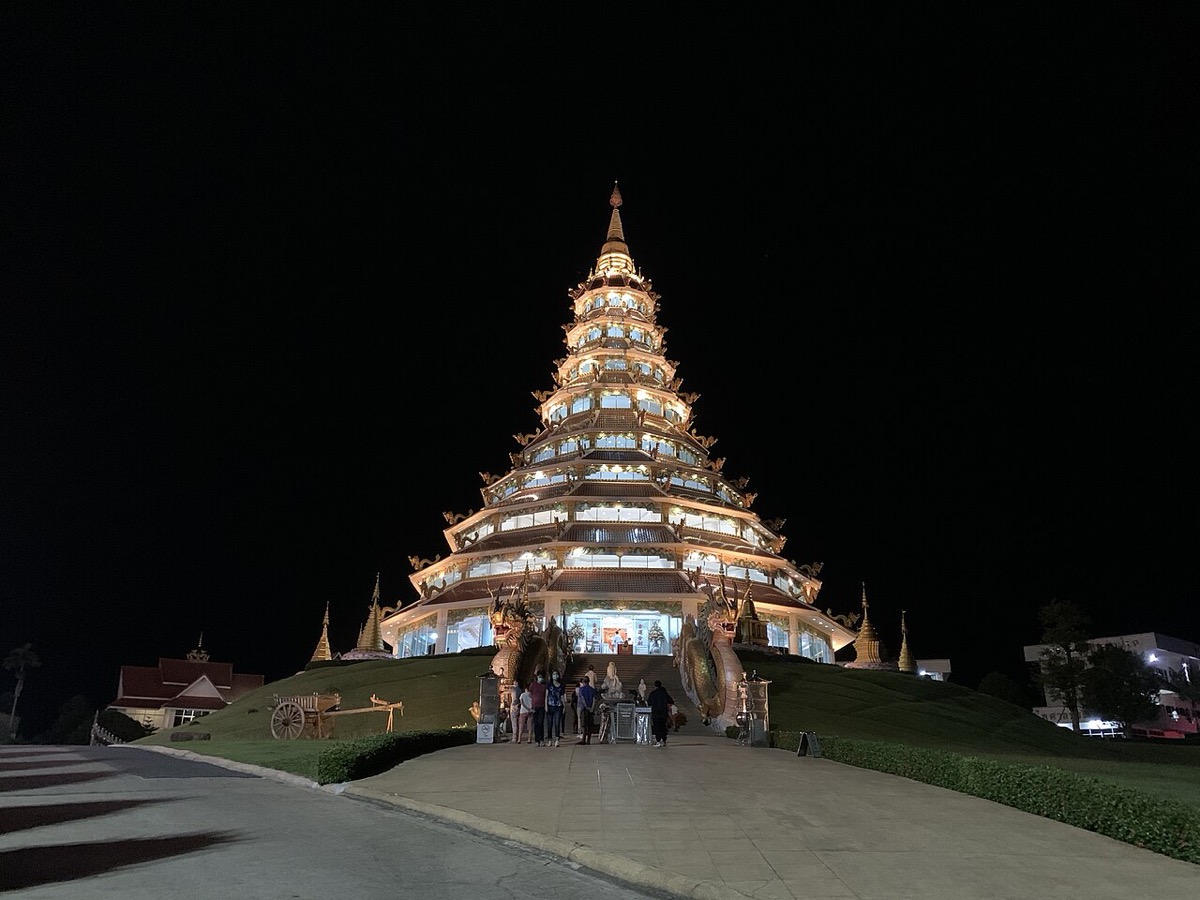
The nine-storey red-roofed Phop Chok Tham Chedi combines Chinese and Lanna styles, with dragon sculptures along the stairs leading to its entrance. A separate white hall has plaster decorations, offering a close look at craftwork in a different scale and material from the 69-metre Guanyin statue seen from afar.
553 Moo 3, Rim Kok, Mueang Chiang Rai, Chiang Rai
The listed address is 553 Moo 3, Rim Kok, Mueang Chiang Rai. Set Wat Huai Pla Kang as your destination.
Local tourism information describes the large white Guanyin statue on the hill as 69 metres tall. From the lower grounds, you can see the hill and statue together; closer up, its white surface and sculpted face come into view. It is also clear here that the complex’s landmark is Guanyin, not a Buddha image.
Going inside the Guanyin statue follows a different route from viewing it in the temple grounds. The lift and viewing area inside may have opening and ticket conditions that differ from those for the outdoor grounds.
The Phop Chok Tham Chedi is a nine-storey tower with red roofs rising tier by tier. It combines Chinese and Lanna styles, and long dragon sculptures line both stairways. After viewing the pagoda from outside, remember that it is also a separate place of worship containing Buddha images and a carved wooden Guanyin.
The Chiang Rai provincial government says the route up the tower is narrow and steep. Check which areas are open on site and take care on the stairs if you go inside. The pagoda is a separate place to worship, beyond the large white Guanyin statue that many visitors photograph from a distance.
The white hall has detailed ornaments modelled in plaster. Unlike the red roofs of the nine-storey pagoda, its white surface brings out the decorative patterns, so you can see different materials and colours among the buildings in the same complex.
The Chiang Rai provincial government says you can see the surrounding hills and town from an upper level inside the Guanyin statue. Conditions for the lift and viewing area may differ from those for the outdoor grounds. The indoor view is inside the Guanyin statue, while the white plaster decorations are in a separate hall.
For all visitors, we recommend wearing clothing that covers the shoulders and knees. A sleeved top with long trousers or a skirt that covers the knees is a good choice. Please dress modestly rather than wearing a sleeveless top or short bottoms.
No. The complex’s landmark is Guanyin, described as a 69-metre statue. The grounds also have a separate nine-storey pagoda with red roofs and a white hall decorated with plasterwork.
Yes. From outside, you can see the large white Guanyin statue, the red-roofed pagoda and the white hall as separate structures. Look at the dragon sculptures along the pagoda stairs and its Chinese and Lanna roof styles. Access to the lift and viewing area inside the statue, including opening and ticket conditions, is separate from visiting the outdoor grounds.
Sources checked:
Sharing image credit: Chainwit. / Wikimedia Commons · CC BY-SA 4.0